At Arcy-sur-Cure, a visit to the Grande Grotte brings together two very different histories: that of a cave shaped by water and that of the humans who left images there. At this site in Burgundy, the underground landscape is part of the encounter with prehistory.
Animals drawn on the rock
The Grottes d’Arcy site features paintings in the Salle des Vagues, where mammoths have a prominent place. The menagerie also includes animals less commonly found in cave art, as well as the handprints of adults and children.
The interest lies in more than simply identifying a species. Simplified outlines, rare details and the use of the rock face’s contours show different ways of bringing a figure to life. The site describes, for example, a female silhouette highlighted in ochre within a natural shape in the rock, visible on the archaeological tour.
The cave is also a water-shaped landscape
The commune’s presentation recalls the galleries carved by the Cure, small pools of water and mineral formations. Stalactites and stalagmites make up another part of the visit: the story of how the underground landscape formed.
The riverbanks also offer an opportunity to extend the visit outdoors. They help place the cave in its surroundings, rather than seeing it as an isolated chamber underground.
Choose your tour before setting off
The site operator distinguishes between an introduction to the Grande Grotte and an archaeological tour. The commune advises booking in advance for organised archaeological tours. It is therefore worth choosing your tour before travelling, according to what you want to understand and how much time you have.
The season runs from April to November. As of 26 October 2026, the site announces that it is open daily during school holidays and closed on Wednesdays outside the holidays. Reception opening times are not the same as tour departure times: you will still need to check the operator’s ticketing service to book a specific time slot.
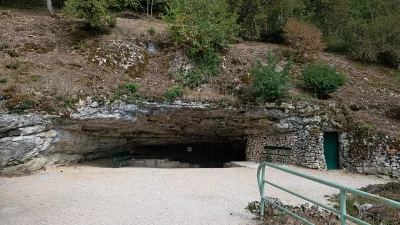
Archive photo, entrance to the Grande Grotte in 2018: Thilo Parg / Wikimedia Commons, CC BY-SA 4.0.