Can a business relationship become an intelligence affair? The accusations concerning contacts between Jensen Huang, Nvidia’s boss, and an official at a Singaporean customer raise that question. They also raise another, more tangible one: when an artificial intelligence chip is sold, how can we know where it ends up and who uses it?
On 30 October 2026, Beijing rejected the accusations reported by the New York Times. Nvidia, for its part, described its exchanges with a customer as routine. To understand this case, three things must be kept separate: the intelligence allegations, the response from those concerned and the mechanisms for monitoring commercial supply chains. Conflating them would turn suspicion into a conclusion.
What is reported and what is disputed
An AFP dispatch published by L’essentiel reports that the American daily, citing anonymous sources close to the investigation, has implicated an official at Megaspeed, a company based in Singapore. The newspaper suspects she worked for Chinese intelligence and refers to the possible diversion of advanced Nvidia chips to China.
Asked at the press briefing on 30 October, Chinese Foreign Ministry spokesperson Guo Jiakun dismissed the account as unfounded and hostile to China. The official transcript makes it possible to verify this response. On its own, it does not prove anything about the alleged events.
Nvidia’s response, as reported by AFP, concerns the normality of the business relationship: Megaspeed is said to be comparable to other regional cloud customers, and meetings between Jensen Huang and their executives are said to be routine. This position should no more be turned into an independent conclusion about where the equipment went.
Closeness between two executives, an intelligence suspicion and the diversion of goods are not interchangeable facts. Each calls for its own evidence: documented exchanges, the precise roles of the people involved, order documents, transport and installation. The sources consulted do not provide the evidence needed to settle the accusations.
The sale does not tell the whole story of the journey
For a graphics card intended for the general public, it is easy to imagine a product being bought and then installed in a computer. Monitoring AI accelerators raises other questions: who orders the equipment, who receives it, where the data centre operates and who benefits from its computing power?
The US Bureau of Industry and Security, or BIS, sets out precisely these kinds of challenges in a note dated 13 May 2025 on diversion risks. It covers, in particular, re-exports and intermediaries who may conceal a user or final destination. This is a background document, predating the Megaspeed affair: it provides no evidence concerning the company.
Consider a fictional example. A company orders servers for a data centre announced in a particular country. The name on the invoice is a first piece of information. It remains to be established that the site exists, can accommodate the equipment and that the conditions of its use match the information provided. A correct invoice therefore does not answer every technical and commercial question.
The example also shows why the nationality of a contact is not enough to establish an offence. The features of the transaction and the rules applicable to it are what need to be examined. An account of a meeting is no substitute for tracing a delivery.
The concrete indicators exporters examine
The BIS note cites several warning signs: a customer whose business does not fit the volume ordered, a residential address for large purchases or an ownership structure that is difficult to understand. It also recommends checking that the data centre has the necessary capabilities, particularly its power supply and cooling.
These indicators call for checks; they are not automatic proof of diversion. The document refers, in particular, to information about the end user, attestations about the infrastructure and, depending on the circumstances, site visits or independent checks. Its date must remain clear: this 2025 note does not, by itself, summarise all the export rules in force today.
The distinction is essential when reading news about semiconductors. A due-diligence measure describes what a seller should look at. An investigation’s findings describe what has been established in a particular transaction. Citing a general list of risks to declare a company guilty would be a shortcut.
What this affair helps us understand
The issue extends beyond Jensen Huang as an individual: AI commerce links manufacturers, intermediaries and infrastructure operators. Identifying the first buyer is not always enough to describe this chain. Conversely, the involvement of several parties does not prove that it is being used to circumvent a restriction.
In this case, the decisive points therefore remain documentary: the actual destination of the equipment, the roles of the companies and the evidence that could substantiate or dismiss the accusations. Any eventual confirmation should concern these specific facts. Until then, neither a diplomatic denial nor a business relationship described as routine settles these questions on its own.
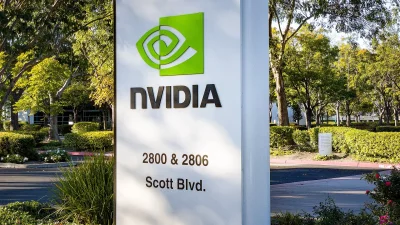
Archive photograph: a Nvidia sign in Santa Clara, California, on 31 October 2020.
Credit: Will Buckner — Wikimedia Commons, CC BY 2.0.