In Bastogne, a visit to the Bastogne War Museum goes hand in hand with the memorial sites around it: Bois Jacques and the Bastogne War Rooms are part of the current individual ticket offer. This allows visitors to connect the account of the Battle of the Bulge with the places where it unfolded. But the sites are separate, so planning how to get between them matters just as much as choosing a ticket.
From the museum to the memorial sites
Located near the Mardasson Memorial, the Bastogne War Museum offers a route devoted to the Second World War and the Battle of the Bulge. According to a feature by Radio France, the story is also told through civilian and military characters, including Émile, a 13-year-old boy during the battle. This approach to interpretation aims to make the conflict’s effects on everyday life more tangible, alongside the historical and military context.
The visit’s appeal also lies in what is outside the building. The permanent exhibition includes the Generations45 experience, devoted to the post-war period through the life stories of an American veteran and a German veteran. The museum’s presentation places this story between 1945 and 1989, from the ruins of Bastogne to the Berlin Wall. It thus shows that the end of the fighting did not bring an end to individual life stories or to the transformations taking place in Europe.
The individual ticket listed by the museum also includes Bois Jacques and the Bastogne War Rooms. This is not a single visit in one building: the three stops need to be planned with their locations and the arrangements for each one in mind.
Three stops, journeys to plan
Bois Jacques is four kilometres from the Bastogne War Museum. The museum says visitors can get there on foot or by car. The site is presented as a battlefield; positions occupied by soldiers and foxholes are still visible. An augmented reality app, mentioned in the Radio France feature, allows visitors to place positions in context. This interpretation does not replace the landscape itself: it accompanies the discovery of traces and a landscape to be approached with respect.
The Bastogne War Rooms are at 40 rue de La Roche. They are housed in the former American headquarters. It was there that General McAuliffe rejected the German demand for surrender on 22 December 1944 with the word “NUTS!”, which has since become famous. The visit helps place this episode in the location associated with the decision, rather than reducing it to a phrase detached from its context.
According to the museum’s practical information, visits to Bois Jacques and the War Rooms can be made within six months of the selected time slot, without any further booking. The permanent exhibition and Generations45 are included in the ticket. This flexibility may make it easier to organise a visit across several stops, but it does not remove the need to check opening times and availability before setting off: the information displayed is subject to change.
Tickets, access and transport
As at 8 November 2026, the museum’s website lists an individual ticket at 28 euros for an adult aged 19 to 64, 24,50 euros for people aged 65 and over, and 15,50 euros for children aged 6 to 18. A family pack, defined as two adult tickets and two children’s tickets, is offered at 72 euros. The listed price includes an audio guide. School groups have a separate offer, so the conditions for individual tickets should not automatically be applied to a class or group outing.
The Bastogne War Museum says it is accessible to people with reduced mobility. This statement applies to the museum: it is not enough to conclude that all three sites, their surroundings or the route between them are suitable for all mobility needs. When planning a visit, it is advisable to check the access arrangements for each stop separately with the relevant operators.
By public transport, the nearest railway station listed by the museum is Libramont. To reach the museum, its website mentions bus line 6 to the Pépinière stop, followed by a 20-minute walk. It also lists line 80 to or from Luxembourg, as well as other routes to Bastogne. As these details do not include timetables or connections, check them with the TEC network before travelling, particularly if the visit is to include several sites in one day.
For visitors travelling by car, the museum lists a paid municipal car park with 200 spaces at the Bastogne War Museum, at a listed rate of 7,50 euros per vehicle. Free car parks are listed at the War Rooms and Bois Jacques. As the sites have separate locations, it is worth planning the journeys before starting the visit.
A visit to plan at your own pace
What Bastogne offers is more than simply ticking off three admissions. It links a museum route, an experience about the post-war period and two places associated with the battle. For visitors coming from Luxembourg, line 80 is a useful reference point, but the connection to the museum and journeys between the sites still need to be planned. If travelling by car, Bois Jacques, four kilometres away, deserves to be treated as a stop in its own right.
Before setting off, check the museum’s opening times and availability, confirm the arrangements for the outdoor sites and check your return journey. The ticket allows visitors to spread the stops out: the museum provides the historical context, while the other two sites bring it to life on the ground.
References
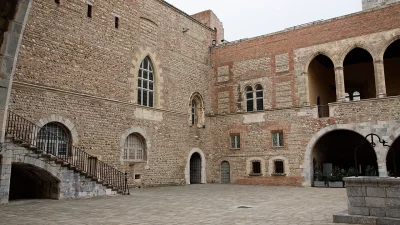
The entrance to the Bastogne War Museum in August 2025. Archive photograph.
Photograph: Paul Hermans — Wikimedia Commons — CC BY-SA 4.0.