At Père-Lachaise, vegetation is more than a backdrop to the monuments. Grass between the stones, trees and areas mown less frequently also provide habitats. On the eve of All Saints’ Day, the France Inter programme featuring Benoît Gallot, broadcast on 30 October 2026 brings this discreet wildlife to the fore. The cemetery’s head describes how maintenance practices have changed. Behind the photographs of fox cubs lies a question worth considering: what allows wildlife to find a place in a cemetery that is still in active use?
A vegetated landscape that is nothing new
The link between graves and trees is part of the site’s history. In 1804, the Mont-Louis estate was acquired to create the eastern cemetery. Charged with its design, Alexandre-Théodore Brongniart worked with the existing planted avenues and groves. The historical account by the City of Paris also shows how the proliferation of tombs subsequently made the space denser, sometimes at the expense of vegetation.
The last extension, in 1850, established a more regular layout on the plateau than the winding paths in the older part. This difference in landscape matters when it comes to looking at the site: Père-Lachaise is not a uniform garden. Its vegetation is therefore neither a recent invention nor a quality that has remained untouched since the beginning. It is negotiated in a space shaped by two centuries of funerary use.
Maintaining the site differently, rather than leaving it untended
The recent change mainly concerns how growth is managed. The City dates the introduction of its “zero pesticides” approach in cemeteries to 2015; before that, they were largely maintained using herbicides. It describes this as a gradual transition, accompanied by the use of mowing and scything. It would therefore be misleading to sum up this change as a decision to stop doing anything.
The differentiated management approach presented by Paris involves adapting maintenance to the purpose and level of use of each area. Some surfaces continue to be maintained regularly; elsewhere, interventions are less frequent. Long grass alone does not tell us whether a place is neglected. We must also consider its function, the paths that need to remain accessible and the space set aside for plants. This distinction helps explain why cleanliness and the total absence of vegetation are not synonymous.
Figures to be read in context of their time period
The municipal fact sheet on the fauna and flora of Père-Lachaise records 62 bird species and more than 220 wild plant species observed between 2010 and 2020. These are observations accumulated over ten years, not a count taken on a single day in 2026. They give an idea of the known diversity, without telling us how many individual animals live behind the walls today.
Small habitats help explain this diversity. Mosses and ferns grow in the gaps between stones; trees provide other spaces for birds. On some banks, cutting the grass just once a year gives plants time to produce seeds and allows small animals to develop. The same fact sheet mentions seven bat species at the site and a breeding fox population there since spring 2020. These details describe an environment used by several forms of life. They are not enough to demonstrate that all their populations are growing.
At night, another use of the same place
In an interview published in June 2021 by the 30 Millions d'Amis Foundation, Benoît Gallot highlighted the role of the cemetery’s closure to the public and the absence of nighttime lighting. He reported fox cubs being born in 2020 and 2021, as well as tits repeatedly using a statue to nest. This earlier testimony sheds light on the conditions that make the site a refuge; it is not a current inventory of its animals.
It also invites us to shift our focus. A place’s ecological value does not depend on being able to photograph a spectacular species during visiting hours. Some of its appeal lies precisely in the periods when human activity recedes. Trying to see an animal at all costs can conflict with what we have come to admire: the tranquillity of a wild animal.
How can we know whether these practices really benefit biodiversity?
To move beyond impressions, observations collected using explicit methods need to be compared. This is the approach taken by the “Living Cemeteries” programme, launched in 2020 by the Île-de-France Regional Biodiversity Agency. Its presentation of the 2022 report outlines a project covering 45 cemeteries in the Île-de-France region and planned to run for four years, from 2020 to 2023. The dissertation presented, however, uses data from the first two years.
Six citizen-science programmes are being used to observe plants, pollinators, birds, hedgehogs and bats, among other things. Researchers are looking at management practices, site features and the immediate surroundings. The aim is to distinguish between their effects, rather than attribute every animal’s presence to a single measure.
This regional programme provides a method for comparison; its objectives should not be recast as specific findings about Père-Lachaise. To conclude that conditions have improved, a species list or photograph cannot replace monitoring that makes it possible to compare periods and observation conditions.
Observing without forgetting the families
Père-Lachaise remains first and foremost a place where funerals are held and loved ones come to pay their respects. The official visitor information page sets out the rules: do not feed the animals, picnic or jog, and respect the privacy of ceremonies. Pets are not allowed, even on a lead. Admission is free; opening times should be checked before setting out, as the cemetery begins to be cleared fifteen minutes before closing.
Looking at mosses, listening to birds or distinguishing the different forms of vegetation does not require leaving the paths or searching for a nest. This quiet attentiveness makes it possible to discover another dimension of the cemetery without disrupting its purpose. Wildlife has a place here, which also depends on the space visitors are willing to leave for it.
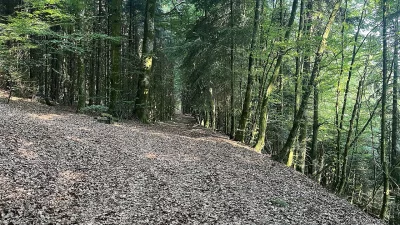
Archive photograph: vegetation among the tombs at Père-Lachaise, February 2010, before the zero-pesticides approach mentioned here. Alexandre Vialle / Wikimedia Commons, CC BY 2.0.