A marsh can keep its soil stable while its plants are damaged. This distinction changes how we understand its role in the face of waves: the stability of the ground and the buffering effect of vegetation cannot be measured using the same indicator.
An experiment presented by Deltares on 21 October 2026 provides evidence to help integrate these environments into coastal protection. The challenge is to assess their contribution alongside dikes, with results that depend on local conditions.
A piece of coastline in a wave flume
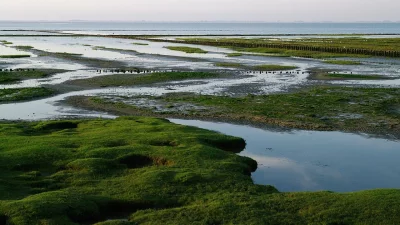
Salt marshes are coastal wetlands that are flooded and then exposed by the tides. NOAA explains that their vegetation, soils and ability to trap sediment help limit erosion. They are also habitats and refuges for many species.
To examine how they behave under strong waves, Pim Willemsen’s team installed 306 square metres of marsh in the Delta Flume in Delft. According to the study published in Nature, the trials began in February 2024, so the results being published in 2026 does not mean the experiment took place then.
The programme lasted about 29 hours, including 21 hours with the above-ground vegetation in place. For the final eight hours, it had been removed to isolate its contribution by comparison.
Stable soil, progressively damaged plants
After the 21 hours with vegetation, measurements showed an average lowering of the soil by 7 millimetres. This is an average, not a guaranteed maximum loss everywhere. The remaining above-ground biomass fell to about 20 to 25 % of its initial value.
The waves tested reached a significant wave height of up to two metres, a statistical indicator of sea conditions. The additional attenuation attributable to the plants ranged from 6 to 22 % for waves of 75 centimetres, compared with 0 to 6 % for waves of two metres. These percentages relate to the reduction in wave height; they describe neither an equivalent reduction in wave energy nor a reduction in flood risk.
A complementary protection measure that needs to be tailored
In its presentation of the work, Deltares distinguishes between the results from the flume and the global-scale assessment. The additional effect of vegetation appears more pronounced on coastlines where the waves above the marsh remain relatively low. A figure obtained in one configuration therefore cannot be turned into a universal promise of protection.
Conserving these environments brings together several functions: habitat, sediment retention and wave buffering. Their continued existence also depends, however, on sediment supply and erosion at their edges. For a coastal project, the question becomes how best to combine the existing marsh, its evolution and the structures to be protected.