More than seven million euros announced does not yet tell us how a forest will recover its functions after a fire. For the Gros Bessillon forest in the Var and the Justin forest in the Drôme, the funds raised through three Mission Nature draws create a funding opportunity. What happens next will depend on the studies, the interventions selected and their monitoring.
The figure was reported on 27 October 2026 by Franceinfo, together with ICI Drôme Ardèche, citing FDJ UNITED. The draws in question took place on 19, 21 and 24 October. This is funding earmarked for restoration, not a record of completed works or a number of hectares already restored.
Where does the funding come from?
FDJ UNITED’s press release of 19 October describes the mechanism: for a €2,20 ticket, 54 cents represent the portion of the stakes normally collected by the State and allocated to this initiative. The full price of a ticket is therefore not devoted to the forests.
The funds raised in this way are intended for projects selected by the French Biodiversity Agency, with the French National Forestry Office and the Conservatoire du littoral among the possible project leads. This distinction between fundraising, selection and implementation matters: the games operator announces funding, while restoration requires decisions and interventions on the sites. The mechanism outlined by FDJ UNITED.
The figure of seven million does not refer either to the amount of prizes paid out to players or to a promise of returns. The subject here is the allocation of funds to environmental projects, not an invitation to gamble.
Two areas, several functions to restore
For Gros Bessillon, the press release cites studies and works to support the ecological regeneration of communal forests, fire prevention and reopening the area to the public. For the Drôme, following the Die fire, it mentions the functions of protecting against natural hazards, producing timber, supporting biodiversity and providing public access.
Franceinfo specifies that the announced funding concerns the Gros Bessillon and Justin forest areas, and covers studies, works and reforestation. The outlet reports that fires affected or burnt 5 700 hectares in the Var and 4 200 hectares in the Drôme. These figures describe the fires mentioned; they do not represent an area promised for reforestation using the announced funding. The information reported on 27 October.
The documents consulted do not provide a financial breakdown between the two forest areas, a detailed schedule of the works or the area covered by each intervention. Dividing the funds raised by the area burnt would therefore produce an apparent cost that does not correspond to an established programme of works.
Restoration does not just mean planting
The general framework for the Mission Nature 2026 call for projects offers a useful distinction. The OFB envisages restoring an ecosystem in its various components and prioritises reducing the pressures that degrade it. The options cited include soil renaturalisation and so-called passive restoration.
The latter term is a reminder that an intervention does not necessarily involve planting: the approach may also focus on creating the conditions that allow the environment to recover. The framework also refers to the long-term protection of land and the regulation of activities that could put pressure on the site.
These are general guidelines, not a technical description of the future works in the Var and the Drôme. They nevertheless make clear that success cannot be reduced to a single tree count. The restoration framework presented by the OFB.
What to look at next
Three stages will be particularly informative in tracking these projects: the precise allocation of resources, the publication of the selected interventions and the observation of their results. They answer different questions. Money committed tells us about the resources; a completed project tells us what was done; ecological monitoring makes it possible to assess what actually changes.
The objectives will also need to be distinguished according to the site. Making public access safe and restoring an environment’s functions cannot be measured using the same indicator. The current announcements set out directions, but not yet the results that will make it possible to assess them.
The fundraising is therefore the start of a process. For residents and visitors alike, the next decisive information will be less about another financial total than about how these funds are translated into localised, documented and monitored operations.
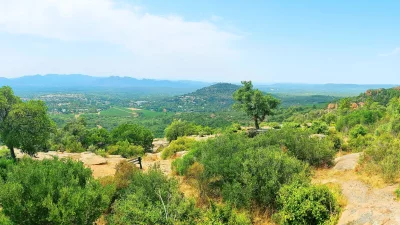
Archive photo: landscape near Bagnols-en-Forêt, in the Var, on 17 July 2023. This view shows neither Gros Bessillon nor the damage caused by the 2026 fires. Photo: Edison McCullen / Wikimedia Commons, CC BY-SA 4.0.


